Technical Details Summary
-
Standard Specifications: API 5L (46th Edition / ISO 3183) Line Pipe Specification
-
Product Specification Level: PSL 2 (Mandatory impact testing, strict carbon limits, maximum strength limits)
-
Delivery Conditions: X52N / L360N (Normalized), X52Q / L360Q (Quenched & Tempered), X52M / L360M (Thermomechanical)
-
Manufacturing Types: Seamless (SMLS), Electric Resistance Welded (API 5L X52 PSL2 ERW Pipes), Longitudinal Submerged Arc Welded (LSAW), Helical Submerged Arc Welded (HSAW)
-
Quality & Verification: EN 10204 3.1 Mill Test Certificates; 100% Non-Destructive Testing (NDT); Open for 100% Third-Party Inspection (TPI)
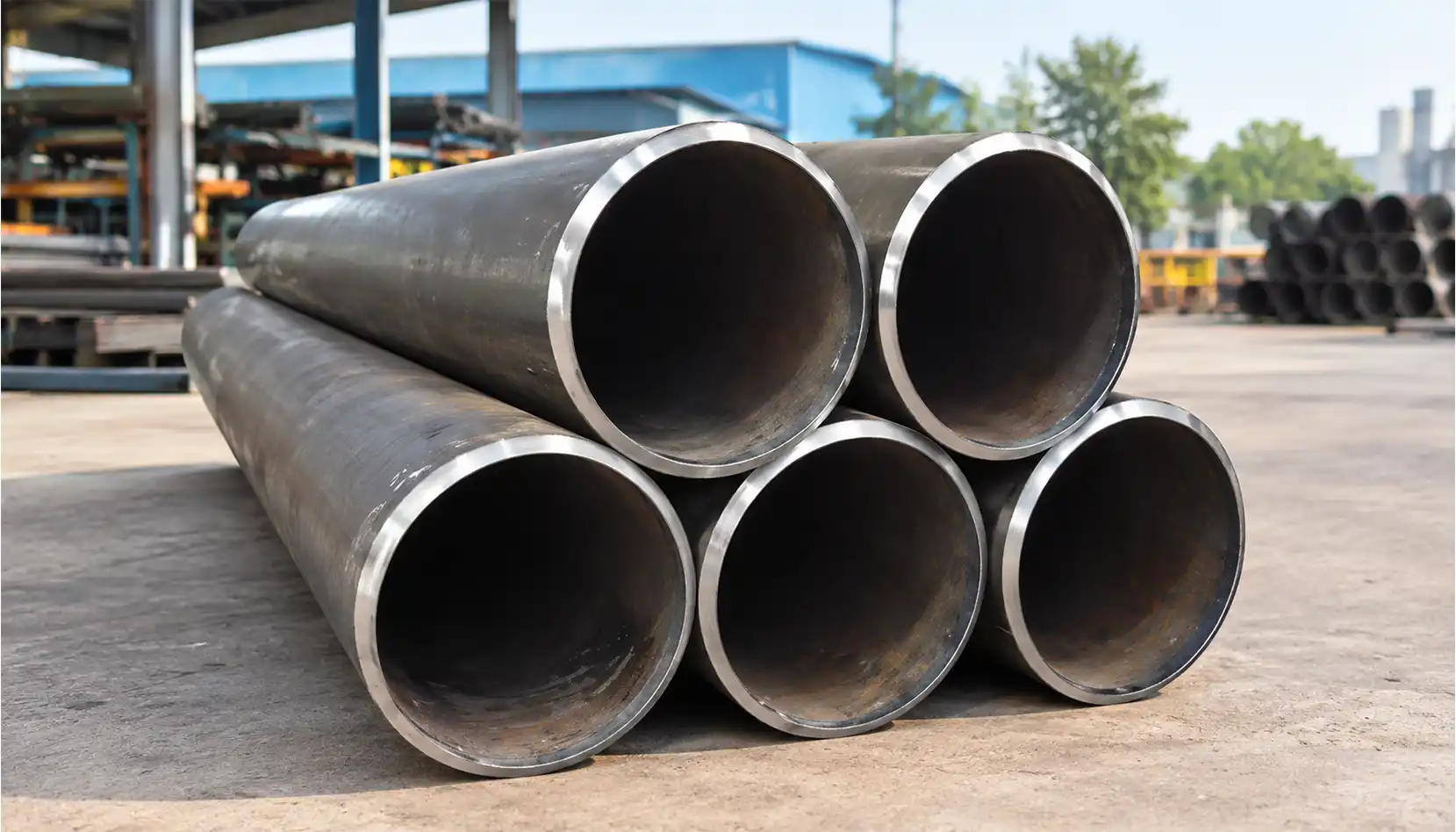
API 5L Grade X52 PSL2 Pipes Overview
Trident Metal & Alloys is a premier API 5L X52 PSL2 Carbon Steel Pipes Manufacturer in India, specializing in strong line pipes made for tough oil and gas pipelines. API 5L Grade X52 PSL2 Pipes (also designated under ISO 3183 as L360N, L360Q, or L360M) are specially made to handle high pressure without cracking under stress.
As a leading API 5L X52 PSL2 Carbon Steel Pipes Supplier in India, we supply both seamless and API 5L X52 PSL2 Welded Pipes. Unlike standard PSL1 pipes used in low-pressure settings, PSL2 grades feature cleaner steel, strict strength limits, mandatory impact testing, and full heat traceability.
We stock seamless and API 5L X52 PSL2 ERW Pipes from 1/2" to 100" outer diameter with custom beveling, cutting, and protective 3LPE or FBE coatings. Every order includes EN 10204 3.1 test certificates and supports 100% Third-Party Inspection.
For general line pipe requirements or standard utility projects, you can also view our complete range of API 5L X52 Carbon Steel Pipes.
Technical Specifications & Manufacturing Range
Manufacturing standards, dimensional capabilities, and end configuration options for API 5L X52 PSL2 pipes.
| Technical Parameter | Specification Limits & Manufacturing Capabilities |
|---|---|
| Standard Specifications | API 5L 46th Edition / ISO 3183, ASME B36.10M |
| Product Specification Level | PSL 2 (Mandatory chemical caps, impact testing, and NDT) |
| Delivery Variant Codes | X52N / L360N (Normalized), X52Q / L360Q (Quenched & Tempered), X52M / L360M (Thermomechanical) |
| Nominal Outer Diameter | 1/2" NPS to 24" NPS (Seamless); 2" NPS to 100" NPS (ERW, LSAW, SSAW/HSAW) |
| Wall Thickness Schedules | SCH 20, SCH 30, SCH 40, SCH STD, SCH 80, SCH 100, SCH 120, SCH 160, SCH XXS (up to 60 mm) |
| End Finish Profiles | Square Cut Plain Ends (PE), Beveled Ends (BE at 30° angle for site welding) |
| External/Internal Coatings | Bare Untreated, Anti-Rust Varnish, 3-Layer Polyethylene (3LPE), 3LPP, Fusion Bonded Epoxy (FBE) |
Chemical & Mechanical Properties of API 5L X52 Pipes
Chemical Composition of API 5L X52 PSL2 Pipes (Max %)
| Chemical Element | X52N / L360N | X52Q / L360Q | X52M / L360M |
|---|---|---|---|
| Carbon (C) max | 0.24% | 0.18% | 0.22% |
| Silicon (Si) max | 0.40% | 0.45% | 0.45% |
| Manganese (Mn) max | 1.20% | 1.40% | 1.30% |
| Phosphorus (P) max | 0.025% | 0.025% | 0.025% |
| Sulfur (S) max | 0.015% | 0.015% | 0.015% |
| Vanadium (V) max | 0.07% | 0.05% | 0.05% |
| Niobium (Nb) max | 0.05% | 0.05% | 0.05% |
| Titanium (Ti) max | 0.04% | 0.04% | 0.04% |
| Carbon Equivalent CEiw max | 0.43 | 0.43 | 0.43 |
| Carbon Equivalent CEpcm max | 0.25 | 0.25 | 0.25 |
Mechanical Properties of API 5L X52 PSL2 Pipes
| Mechanical Parameter | API 5L X52 PSL 2 Requirement |
|---|---|
| Minimum Yield Strength | 360 MPa (52,200 psi) |
| Maximum Yield Strength | 530 MPa (76,900 psi) |
| Minimum Tensile Strength | 460 MPa (66,700 psi) |
| Maximum Tensile Strength | 760 MPa (110,200 psi) |
| Yield-to-Tensile Ratio (Max) | 0.93 |
| Individual Absorbed CVN Impact Energy | 20 Joules Min (at 0°C or -20°C) |
| Average Absorbed CVN Impact Energy | 27 Joules Min (at 0°C or -20°C) |
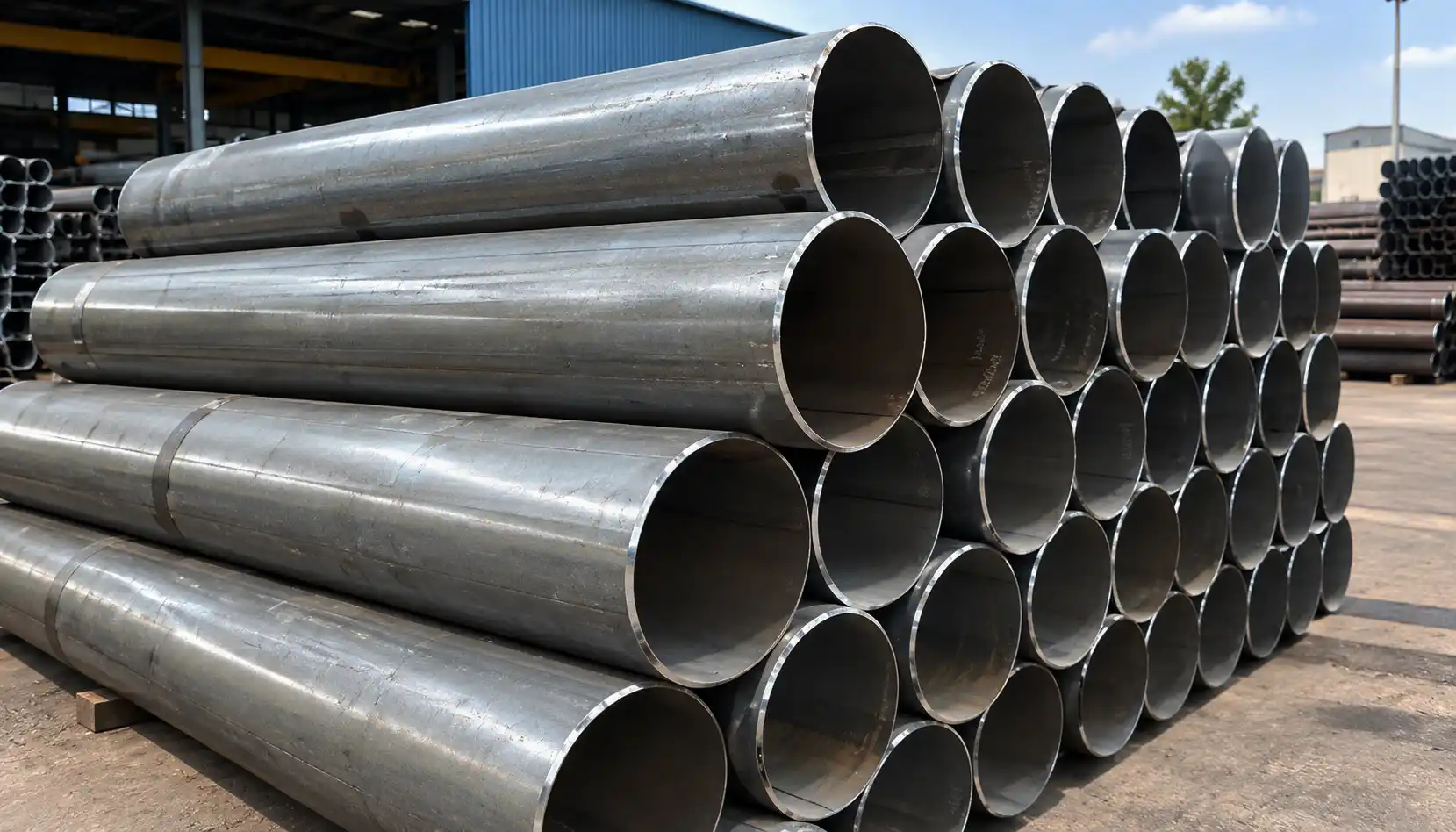
Engineering Advantages of API 5L X52 PSL2 Pipes
Tough Under Sudden Pressure
Every batch undergoes mandatory impact testing so these pipes will not snap or crack suddenly during pressure spikes or freezing cold weather.
Controlled Metal Strength
Clear limits are set for both minimum and maximum strength, ensuring the pipe expands safely before any failure occurs during ground movement.
Easy On-Site Welding
Low carbon content allows quick, simple welding in the field without needing extra heating steps before welding.
Cleaner Metal Quality
Low sulfur levels mean fewer internal defects, giving the pipes high resistance to cracking in harsh wet or sour gas environments.
Primary Industrial Applications for API 5L X52 PSL2 Pipes
Oil & Gas Lines
Long-distance pipelines carrying crude oil, natural gas, and fuel safely under high pressure.
Offshore Platforms
Subsea risers and flowlines subject to ocean waves and heavy sea environments.
City Gas Networks
Main gas supply pipelines passing through busy urban areas where safety is the top priority.
Refinery Processing
High-pressure lines moving hot oil, gas, and chemical fluids inside refining plants.
Grade Comparison: API 5L X52 PSL1 vs API 5L X52 PSL2
Comparative technical evaluation between standard PSL1 and enhanced PSL2 specification levels for API 5L X52 line pipe.
| Parameter | API 5L X52 PSL1 | API 5L X52 PSL2 |
|---|---|---|
| Impact Testing (CVN) | Not mandatory | Mandatory for all heats (0°C or -20°C) |
| Upper Yield Limit | Unspecified (No upper cap) | Capped at 530 MPa Max |
| Upper Tensile Limit | Unspecified (No upper cap) | Capped at 760 MPa Max |
| Yield/Tensile Ratio | Unspecified | 0.93 Max |
| Sulfur (S) Content | 0.030% Max | 0.015% Max (Cleaner steel) |
| Weld Seam Testing | Sample testing allowed | 100% NDT (Ultrasonic testing) required |
| Pipe Traceability | Basic batch tracing | Full individual pipe heat tracking |
Regional Supply Across India
Western Region (Maharashtra & Gujarat Industrial)
We supply API 5L X52 PSL2 Carbon Steel Pipes directly to offshore bases, refineries, and stockyards across Mumbai, Pune, Thane, Navi Mumbai, Ahmedabad, Surat, Vadodara, Rajkot, Hazira, and Jamnagar.
Northern & Central Region (NCR, Punjab & Madhya Pradesh)
Direct distribution channels for pipeline projects across Delhi NCR, Faridabad, Gurgaon, Ghaziabad, Noida, Ludhiana, Indore, and Bhopal.
Southern Region (Tamil Nadu, Karnataka, Telangana & Andhra Pradesh)
Regular dispatches of high-yield carbon steel pipes to power plants, shipyards, and gas hubs in Chennai, Coimbatore, Bengaluru, Hyderabad, Visakhapatnam, and Kakinada.
Eastern Region (West Bengal, Odisha, Jharkhand & Chhattisgarh)
Bulk supply of line pipe for slurry pipelines and industrial projects in Kolkata, Durgapur, Rourkela, Jamshedpur, Bhilai, and Paradip.
Quality Verification & Material Documentation
Trident Metal And Alloys subjects all API 5L X52 PSL2 Carbon Steel Pipes to rigorous destructive and non-destructive quality checks prior to project dispatch.
Mill Test Certificates (MTC)
Fully compliant EN 10204 3.1 MTCs containing heat analysis, tensile curves, Charpy impact logs, and hydrostatic pressure reports.
Third-Party Verification
Open to 100% inspection by TUV, SGS, Bureau Veritas, DNV, or Lloyds to meet global project criteria.
Non-Destructive Testing
All API 5L X52 PSL2 Welded Pipes undergo 100% full-body ultrasonic or electromagnetic weld seam testing to guarantee zero structural defects.
All dispatches comply with dimensional tolerances established across our broader Carbon Steel Pipe Product Ranges.
Frequently Asked Questions
Q: What makes API 5L X52 PSL2 different from standard PSL1 pipe?
A: PSL2 sets strict upper strength limits, requires lower sulfur limits, mandates impact testing, and requires 100% weld seam testing to prevent sudden pipe failure.
Q: What do the letters N, Q, and M mean in X52N, X52Q, and X52M?
A: These refer to heat treatment methods: "N" means Normalized, "Q" means Quenched & Tempered (for higher strength), and "M" means Thermomechanical Rolled (for easy welding).
Q: Are API 5L X52 PSL2 ERW Pipes suitable for sour service pipelines?
A: Yes, when ordered with NACE MR0175 / ISO 15156 testing, as PSL2's restricted chemistry and controlled hardness prevent cracking in sour gas environments.
Q: What impact testing temperatures are standard for PSL2?
A: Impact testing is usually performed at 0°C or -20°C depending on project needs, requiring a minimum average toughness of 27 Joules.
Q: What test reports come with the pipe shipment?
A: Every dispatch includes official EN 10204 3.1 Mill Test Certificates showing chemical composition, tensile strength, impact test values, and hydrostatic test reports.
Request a Quote
Partner with Trident Metal And Alloys for competitive pricing, certified PSL2 mill stock, custom beveling, and fast dispatch across India and global markets.
- Email Inquiries: tridentmetal96@yahoo.com
- Direct Phone / WhatsApp: +91 9619282829 / +91 9619966304